
Walk a Sioux City Street
A sound Sioux City street directory search moves from the address to records with dates. Ownership is visible through tax and land records, but ownership does not prove that the owner lives there. The city assessor route points to Beacon for Sioux City parcels. The Recorder supplies the recorded transfer, while historical directories and census schedules can add dated evidence of an occupant. The public voter lookup is name-and-ZIP based, not a street roster, so it should confirm a known name rather than supply names for a block.
- Verify the complete address and delivery ZIP through USPS. Keep unit and directional words exactly as returned.
- Follow the Sioux City assessor property-search route. Capture the parcel ID, situs, mailing address, deed holder, tax description, and data date.
- Use the mapped parcel and legal description to distinguish adjoining lots and similar street numbers. Note any split, merge, or retired parcel identifier.
- Follow the transfer-book reference to the Woodbury County Recorder, then retrieve the dated deed through Cott, Iowa Land Records, or the office.
- For an older household, test the exact address in a criss-cross directory, census, newspaper, and dated map. Record what each source actually says.
This sequence keeps owner, occupant, voter, and postal facts distinct. It also gives the search a fallback when Beacon is blocked, as it was during the research inspection. The assessor can provide an existing parcel card; ArcGIS can confirm geometry; the Recorder can supply the controlling instrument.
Write down the query as well as the result. A useful street log includes the exact address entered, source URL, search date, returned parcel or document number, record date, and access status. Mark a failed page as blocked rather than “no record.” For a row of Sioux City lots, repeat the same fields for each parcel so a corner lot, vacant tract, or shared mailing address does not distort the sequence. The result is evidence arranged by street, not a claim that every named owner is a current resident.
Sioux City Parcel Evidence
Beacon is the official property-search handoff for both the Sioux City and Woodbury County assessor pages. The general parcel application returned a block during inspection, so its exact live form fields cannot be claimed. A county meeting packet preserved a sample Beacon parcel report. It shows why a by-address search must capture far more than an owner label.
| Captured field group | Useful details | How to read it |
|---|---|---|
| Identity | Parcel ID, alternate ID, property address | Fixes the tax parcel at the report date |
| Ownership | Deed holder, contract holder, mailing address | Shows tax and legal roles, not every occupant |
| Land | Lot area, acres, tax description, zoning | Use the deed for the controlling legal description |
| Structure | Year built, style, rooms, basement, garage | Appraisal traits may be corrected or updated |
| Value | Land, building, gross, exempt, net | A dated assessment, not a sale price |
The property address is the situs, meaning the place where the parcel sits. The tax mailing address is where correspondence goes and may be outside Sioux City. A Sioux City street directory entry should never turn that mailing field into a claim of residence.
The sample report also includes school district, neighborhood, deed book/page, year built, living area, rooms, bedrooms, basement, heating and cooling, garages, and outbuildings. These details help distinguish two similar parcels and compare a building with an old map. They remain assessor data created for taxation. If a field is blank, note it as blank. Do not call it withheld or absent from the agency unless the custodian confirms that status.
Sioux City Street Number Rules
Sioux City has an unusually useful address clue in Chapter 20.44. The numbering scheme has an effective date of January 1, 1901. It uses directional divisions, odd-and-even side rules, and increments of 100 for each block. Irregular additions receive special treatment. Those rules can explain why an address in an old directory seems one block away from the modern parcel.
Check the codified Sioux City street-numbering rules against a map from the same period. Preserve directional prefixes and suffixes. If the street was renamed, the city application process calls for a petition, notice to adjacent owners, contiguous alignment review, and an ordinance effective date. That date is the bridge between old and current names.
- Parcel
- A mapped tax unit with its own identifier.
- Situs address
- The physical address assigned to the parcel.
- Plat
- A recorded map dividing land into lots, blocks, streets, or tracts.
- Criss-cross directory
- A directory arranged by street and number instead of only by surname.
Map Sioux City Parcels Carefully
The Woodbury ArcGIS parcel item exposes technical geometry such as parcel name or PIN, stated and calculated area, record lineage, validation status, and shape measurements. The inspected attribute table did not expose a public resident name or owner-address field. Use it to confirm the polygon and parcel lineage, then return to the assessor or Recorder for ownership evidence.
City maps add zoning and planning context. The official zoning map includes agricultural, industrial, business park, general commercial, neighborhood conservation, rural residential, general residential, suburban commercial, downtown commercial, commercial entertainment, and suburban residential classes. Zoning describes land use, not a person. Always save the layer date because a district may change while ownership stays the same.
Jurisdiction matters at the city edge. A Sioux City parcel normally follows the city assessor route, while unincorporated Woodbury land follows the county assessor. Both routes may point to Beacon, but that does not make their keepers interchangeable. When a street crosses an annexed or unincorporated area, check which assessor holds the parcel before comparing owners. The deed remains with the Woodbury Recorder, and the city zoning layer should not be projected onto land outside its reach.
Deeds Along Sioux City Streets
The Recorder's land workflow connects a physical lot to a dated instrument. For a town parcel, search the Auditor's Transfer Books by addition, block, and lot. Rural descriptions use section, township, and range. Write down the parties, transfer date, document type, legal description, and book/page or roll/image reference. Then retrieve the deed through Iowa Land Records or request it from the office.
The county states that its Cott transfer-book workflow covers 1960 through February 24, 2020. Older books remain an office or archive route. The street directory trail therefore changes channel at that boundary rather than ending.
Iowa Land Records offers a free statewide real-estate index when the document is present. If the image cannot be opened, give the Recorder the book/page, roll/image, instrument number, exact parties, or recording date. A narrow request is more reproducible than asking the office to create a full street history. For many parcels, request a cost estimate first and keep a separate row for each legal description.
The Woodbury Cott transfer-book portal is the online handoff documented by the county.
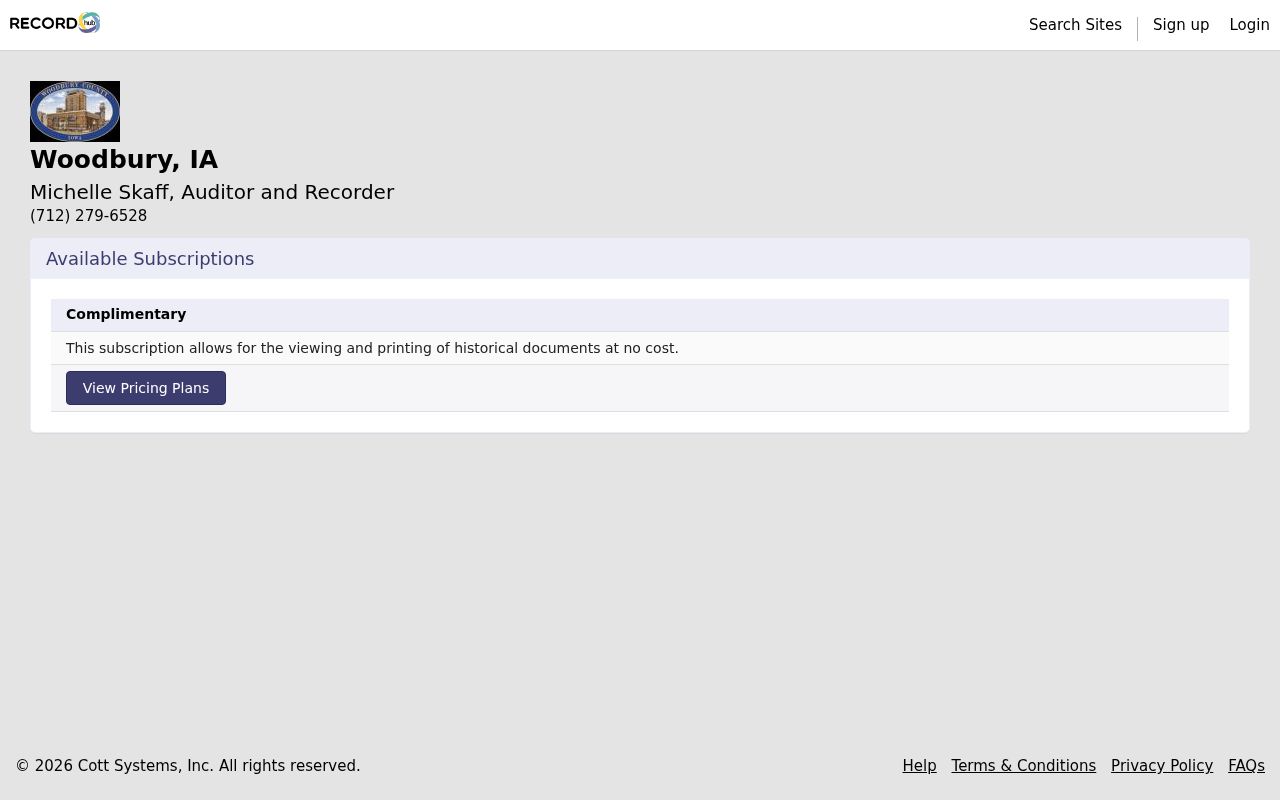
The capture shows the correct system and organization route. A subscription screen appeared during inspection, so an office request or Iowa Land Records may be needed when the desired book or image is not available.
Sioux City Records by Street
No single public roll names everyone at a Sioux City address. Each source answers a narrower question. The strongest street directory work records the keeper, date, access route, and limit for each source before comparing names.
| Record Set | Keeper | What It Shows | Access |
|---|---|---|---|
| Property and tax roll | Sioux City Assessor | Parcel, deed holder, situs, mailing, structure | Beacon route; assessor fallback |
| GIS parcel geometry | Woodbury County and City Maps | Polygon, PIN, area, zoning context | ArcGIS and city map pages |
| Deeds and transfers | Woodbury Auditor & Recorder | Dated parties, instrument, legal description | Cott, Iowa Land Records, office books |
| Postal and election routing | USPS and County Auditor | Delivery ZIP, precinct and polling route | Online lookup; phone fallback |
| Permits and inspection files | Sioux City Inspection Services | Requested alteration or structure records | Office request; no public history index captured |
The parcel ID joins assessor, geometry, and tax evidence. The legal description joins that parcel to deeds. Street and ZIP route postal and election checks. When a portal fails, call or write to the keeper with a narrow request for an existing record and a defined date.
The Iowa voter form requires first name, last name, and five-digit ZIP. Its visible fields do not accept a street address. Woodbury Elections instead accepts a ZIP or city to return polling and sample-ballot routes, and its precinct page can be searched by precinct, location name, or township. These are routing checks. Iowa law restricts broader voter-list products to stated lawful purposes and bars commercial use, so they should not be repurposed as a street directory.
Sioux City Streets Across Eras
Official Sanborn fire-insurance maps survive for Sioux City in 1884, 1886, 1890, 1924, and 1949. They show structure footprints, materials, floors, mapped use, and street context. They do not identify every occupant. Compare the address, cross streets, block, addition, and building outline before linking a map structure to a directory entry.
The Library of Congress 1888 perspective map adds city-scale context between the early plat and later parcel systems. It can locate a railroad, riverfront tract, civic building, or industrial site. For residents by street, the map is best used to test continuity, not to infer a household.
Sioux City's geography can change the best search words. The riverfront core, Floyd and Missouri river corridors, old additions, rail lines, and later neighborhoods may appear under a landmark or addition name rather than a current neighborhood label. Search both forms in newspapers and maps. Neighborhood Network names such as Leeds, Riverside, Westside, Northside, Morningside, Crescent Park, and Jones Street are useful civic terms, but the network publishes no member directory.
Sioux City Permits by Address
Sioux City Inspection & Permit Services handles permit and inspection questions. The research found permit categories and an office route, but no public municipal address-history index or reliable historical online span. Lead with the counter or a focused Chapter 22 request. Give the full address, parcel ID if known, permit type, and date range.
Permit evidence can date an addition, demolition, move, garage, or major alteration. It does not prove who occupied the building. Woodbury County's August 2026 notice says moving permits can now be submitted online and paid by credit card, but the live form and current terms should be checked before relying on them.
City Clerk records may also help when a street name, plat action, or council decision is the key event. Ask for an existing ordinance, resolution, petition, or council record by subject and date range. The City Clerk is the public-information contact for city records, while Inspection Services keeps permit material. Splitting the request by custodian is faster and leaves a clear source trail. Under Iowa Code Chapter 22, request an identifiable existing record rather than asking staff to write a new history of the address.
Past Sioux City Residents by Street
For an older address, a criss-cross or street section can place a listed householder or telephone subscriber at a number in a specific year. The Aalfs Downtown Library holds Polk directories and telephone books in its local-history collection. Library staff also offer newspaper and genealogy research routes. Exact years, publishers, shelf access, and how entries read belong to the Sioux City city directory collection.
Pair a directory hit with a census, deed, obituary, or newspaper image. A missing listing may mean an unlisted number, a spelling change, an OCR error, a move between editions, or a street-number change. It is not proof that no one lived there.
Aalfs local-history research can also reach Sioux City Journal microfilm, yearbooks, and licensed genealogy resources. Supply the street number, both old and current street spellings, a narrow year range, and any known surname. Staff research is most useful when the request asks for a specific directory entry or newspaper date. Save the volume year and page, since an index transcription without its image can hide an abbreviation or OCR mistake.
Sioux City Street Directory Limits
Tax records show legal and mailing roles, not a complete household. A deed names parties to a transfer, while a voter lookup accepts a known first name, last name, and ZIP. It does not publish a full street address list. Utility accounts and motor-vehicle address data are not open resident directories. Safe at Home and Protect Our Protectors can also keep qualifying addresses out of normal public routes.
Keep negative results precise. “Blocked,” “not indexed,” “not public,” and “not found with this query” mean different things. The Beacon general search was blocked during inspection, ArcGIS lacked owner names in the captured schema, and no municipal permit-history portal was located.
Lawful use. Use Sioux City address records for lawful personal research. Never use them to stalk, harass, intimidate, or defeat an address-confidentiality program.