
Sioux City Previous Resident Sources
Different eras call for different records. A current parcel card starts the physical trail, but it is only a tax snapshot. Transfer books and deeds supply dated owners. Directories and census schedules add people associated with the address. Maps and permit files explain what stood on the lot when those people were there.
| Source | Years It Covers | Where Held | What It Shows |
|---|---|---|---|
| Woodbury transfer books | 1960 through 02/24/2020 online workflow; older office books | Recorder and Cott | Addition, block, lot, transfer sequence, roll or image |
| Historical land groups | Land transfers 1855-1918; town lots 1856-1920; other groups vary | State Historical Society microfilm | Transfers, patents, tax sales, homesteads, indexes |
| Directories and telephone books | Indexed leads from 1889-93; national runs from 1929-58 | Aalfs Library, FamilySearch, LOC, NARA | Dated occupants, subscribers, addresses, occupations |
| Federal census | Released through 1950; 1890 destroyed | Library databases and archives | Household, age, relationship, work, and location |
| Sanborn maps | 1884, 1886, 1890, 1924, 1949 | Sioux City map PDFs | Structure footprint, material, floors, use, street context |
| Permit files | Categories known; online history span not located | Sioux City Inspection Services | Requested alteration, addition, move, or demolition records |
For a recent transfer, start with the assessor and Recorder. For an early twentieth-century household, start with a directory year near a census and then verify the parcel on a Sanborn sheet. Before the online transfer span, follow book references at the Recorder or use state-held microfilm.
Build an evidence table with one row per dated event. Record the source, exact query, name, role, address as printed, legal description, date, page or instrument identifier, and confidence. High confidence needs two independent dated sources with the same name and address, or a recorded instrument paired with a directory or census entry. A name-only hit is low confidence. Preserve conflicts instead of smoothing them into one story.
Start With the Sioux City Parcel
Use the Sioux City assessor property-search route to identify the current parcel ID, situs, tax mailing address, deed holder, addition, block, lot, and brief tax description. Record the report date. The live general Beacon application was blocked during inspection, so the assessor office is the proper fallback for an existing parcel card or a historical card.
Keep each layer separate. The situs is the physical address. The mailing address receives tax notices. The parcel ID is an assessor key that can change after a split or merge. The legal description in the recorded deed controls the transfer. A brief tax description is useful for searching, but the county warns that it is not a substitute for the legal description.
A county meeting packet preserves a detailed Beacon parcel-card sample even though the general portal was blocked. It includes deed and contract holders, mailing address, land area, zoning, district, school district, neighborhood, year built, style, rooms, basement, garages, and valuation. Use those fields to identify the current asset and its structure. None proves that a named person slept at the property, and no captured homestead field supports an owner-occupancy claim.
Trace Woodbury County Deeds Back
A chain of title is the sequence of recorded transfers for one legal parcel. Work from the present toward the past. For a Sioux City lot, the county's transfer-book instructions use addition, block, and lot. Each reference should lead to the dated instrument rather than to a guess based only on the street number.
- Copy the parcel ID, situs, addition, block, lot, and current deed holder from the dated parcel card.
- Locate that owner's purchase in the transfer book. Save the date, parties, type, and book/page or roll/image.
- Retrieve the deed through Iowa Land Records, Cott, or the Recorder. Confirm that its legal description matches.
- Search the seller in the earlier grantee role to locate that party's purchase. Repeat only when the description still matches.
- At the online boundary, move to Recorder books or State Historical Society microfilm instead of treating the chain as finished.
- Grantor and grantee
- The grantor gives or sells an interest; the grantee receives it.
- Chain of title
- The dated sequence of recorded transfers affecting the same land.
- Legal description
- The lot, block, addition, or land description that identifies the property despite address changes.
At each transfer, compare the deed date with the recording date and copy the full legal description. Similar names are common. The matching lot, block, addition, and prior instrument are stronger than a shared surname. If the parcel was split or merged, ask the assessor for a former PIN or historical card, then trace each resulting legal tract separately.
Sioux City Deed Access Channels
Iowa Land Records is free to search, but every historic Woodbury image is not guaranteed online. Cott is the county's transfer-book route and showed a subscription screen during inspection. The Woodbury County Auditor & Recorder remains the fallback at 620 Douglas Street, Room 106, on weekdays from 8:00 a.m. to 4:30 p.m. Real-estate questions use 712-279-6603.
The Iowa Land Records gateway can supply the statewide document route once a reference is known.
The source is best used with an exact party, date, instrument number, or book reference. If an image is absent, send those details to the Recorder rather than broadening the identity claim.
The Recorder page says Woodbury real-estate records reach back to the mid-1800s. Access is not all online. In-person books, an office copy request, Cott, Iowa Land Records, and state microfilm are complementary channels. Record which channel was searched. “Not online” means only that the digital route did not supply the image.
Order Sioux City Property Records
The Recorder publishes both forms and a fee page. Choose the land-record or copy route that matches the desired record, and ask for an estimate before ordering a long chain. A certified copy is an office-authenticated copy; a portal image may be useful for research but is not the same product.
The Woodbury Recorder forms page gathers the office's real-estate forms.
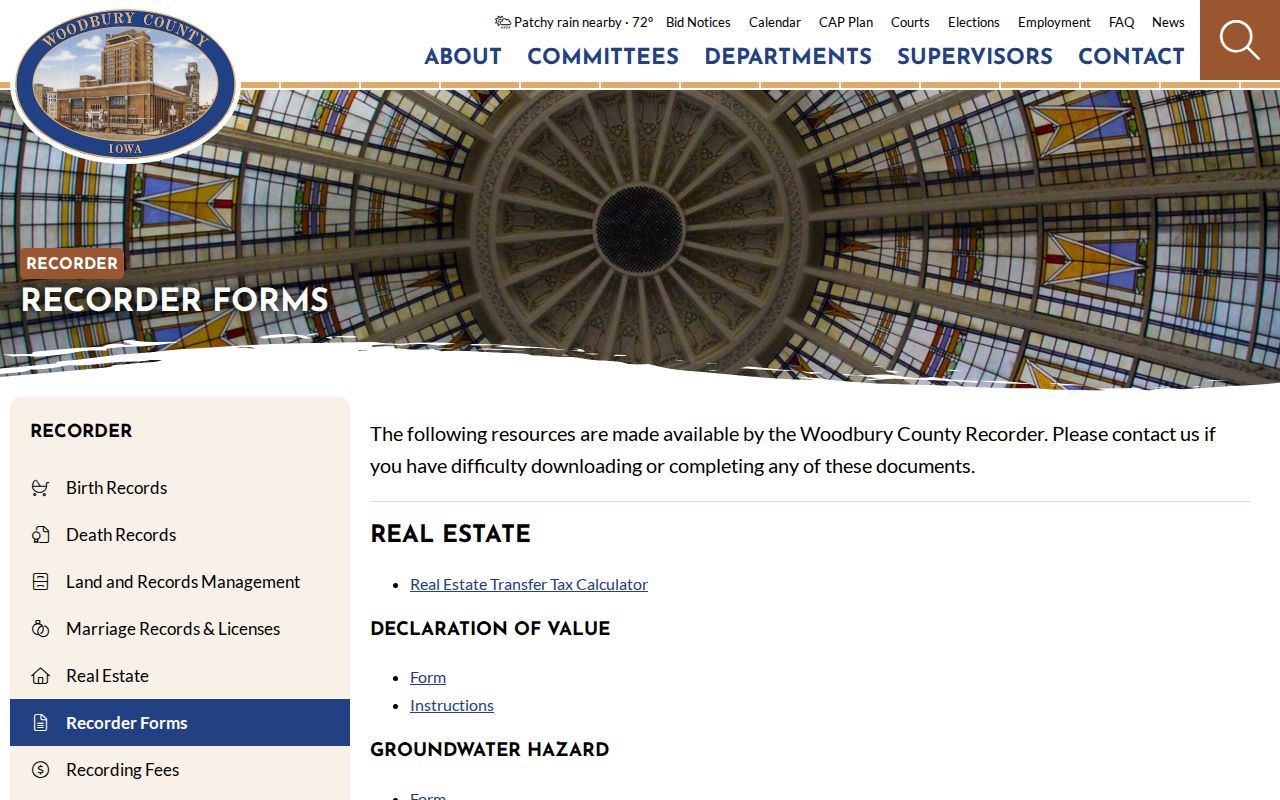
Use the form title and mini-department when contacting the combined Auditor & Recorder office. Land records, real estate, and vital records begin at the same office but follow different rules.
The current Recorder fee schedule is the source for copy, search, certification, and recording charges.
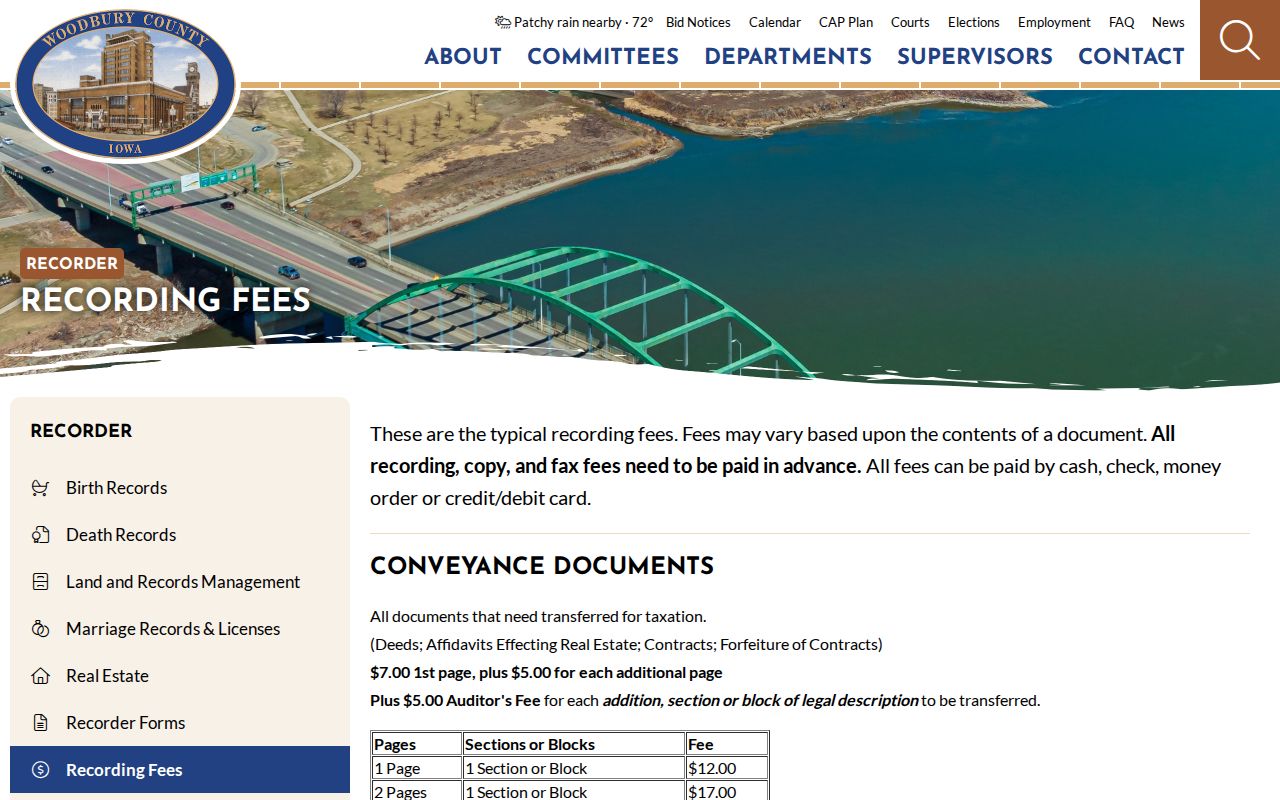
Check that page at the time of the request. Fees and payment rules can change, and a multi-instrument house history may need a written estimate.
The office combines Auditor and Recorder functions, with separate land and records, real estate, and vital work. State the mini-department and requested product. A deed copy needs a land reference; a parcel correction goes through the assessor or real-estate route; a certified event record follows separate entitlement rules. Clear routing prevents a false handoff inside the same courthouse address.
Older Sioux City Land Records
The State Historical Society of Iowa bridges the years before the modern workflow. Its Woodbury groups include real-estate transfers for lands from 1855 to 1918, town-lot transfers from 1856 to 1920, land indexes and records from 1855 to 1901, town-lot indexes and records from 1855 to 1903, deeds patent from 1875 to 1911, and homestead material from 1879 to 1935. Separate tax-sale and miscellaneous groups cover other spans.
The official Woodbury County holdings inventory gives the current date ranges.
The inventory turns an online gap into a precise microfilm request. Cite the group, span, party names, and legal description when asking staff for help.
Other Woodbury groups can close the last part of a life or ownership trail. Tax-sale land spans 1861 to 1941, town-lot tax sales span 1868 to 1901, and miscellaneous records span 1855 to 1925. Probate and vital groups may point to heirs or a death, subject to their own access rules. Use them as dated records, not as proof that every heir occupied the house.
Map Previous Sioux City Residents
Sioux City's Sanborn sets for 1884, 1886, 1890, 1924, and 1949 can confirm that a structure existed and show its outline, construction, floors, use, and nearby streets. The 1888 Library of Congress perspective map adds citywide context. Neither map proves who lived inside. Link the map to a directory or census entry from the same period.
Address numbering adds a local trap. Chapter 20.44 preserves an effective date of January 1, 1901, odd-and-even parity, directional divisions, 100-number block increments, and rules for irregular additions. If past residents vanish between editions, test a renumbering or rename before concluding that the household moved.
Compare each old number with cross streets, the addition, block and lot, and the structure outline. A street-renaming application can supply petition, notice, alignment, and ordinance dates. Those dates help explain why the same building appears under two names. A current ZIP does not solve this issue, since older sources may predate ZIP codes and postal zones are not parcel boundaries.
Sioux City Structure Changes
Ask Sioux City Inspection & Permit Services for existing files tied to the full address, parcel ID, permit category, and a narrow year span. No complete public historical permit index was captured. The counter or a focused Iowa Code Chapter 22 request is therefore the lead route.
Permits can show an addition, demolition, building move, garage, or other change that explains why a map footprint differs. They may name an applicant or owner in a dated role, but they do not identify all previous residents.
The absence of a permit result is weak evidence when the historical online span is unknown. Ask what files exist for the address, whether older records are arranged by parcel or owner, and whether a former address number must be searched. Preserve the custodian's response and request date beside the map and assessor findings.
Sioux City Past Household Trail
Owners are only half of an address history. Directories may name a householder, spouse, occupation, or telephone subscriber. Census schedules can show the household and relationships at an enumeration date. An enumeration district is the area assigned to a census taker. It is not a ZIP or permanent neighborhood boundary.
- Choose a directory year and copy the entry exactly, including initials, street form, occupation, and page.
- Locate the address on the nearest Sanborn sheet and note cross streets, block, and structure.
- Use the closest released census to test names and household relationships.
- Compare the names with the deed owner, keeping owner and occupant as separate roles.
- Use newspapers, obituaries, cemetery records, and probate to explain arrivals, departures, deaths, or heirs.
Aalfs Library holds local Polk directories and telephone books and provides local-history research. FamilySearch, the Library of Congress, and NARA add digitized or cataloged runs. The collections themselves are described on the Sioux City city directory page. A missing name can reflect an unlisted phone, OCR error, alternate spelling, absent volume, or move between publication dates.
Newspapers can bridge directory years. Aalfs provides Sioux City Journal microfilm from 1864 to 1922 and licensed newspaper routes for later periods. Search the surname with the address, cross street, school, business, or neighborhood term. An obituary can connect relatives and a former address; probate can identify an estate and heirs. Confirm each clue in the original image or court file because OCR and family notices can contain errors.
Lawful use. Research previous residents for house history, genealogy, heirs, or personal curiosity. Never use the trail to harass or track a living person.