
Sioux City Directory Runs
Sioux City city directory research spans several collections, and no official source publishes one complete year-by-year list. The strongest local shelf is at the Wilbur Aalfs Downtown Library. Its local-history handout identifies Polk directories and phone books at Local History 917.77. Public and licensed digital sources cover selected years, while census compilations help with the earliest period. Confirm an exact volume with the holding library before making a trip.
| Collection | Years represented | Where held | Access route |
|---|---|---|---|
| Woodbury and Sioux City compilations | 1856 and 1880 | FamilySearch catalog and WCGS | Catalog or society finding aid; check the source record |
| Indexed city directories | 1889-90 and 1892-93 | FamilySearch and Ancestry collections | Collection terms or library access apply |
| NARA directory holdings | 1929-32 | National Archives guide | Holding identified; exact scan access varies |
| White and Yellow telephone books | 1936-40, 1941-45, 1956-58 | Library of Congress | Free public scans |
| Polk directories and phone books | Exact shelf run not posted | Wilbur Aalfs Downtown Library | Ask staff; onsite and licensed resources |
The gaps matter. A missing online volume does not show that no Sioux City city directory was issued. Aalfs staff can check the physical run, while the FamilySearch catalog can be searched by place, title, author, subject, surname, and availability. Telephone books also omit unlisted numbers and favor subscribers, so absence from one book is weak evidence.
Sioux City Library Directory Shelf
The Aalfs local-history service is the practical first stop when a needed year is not freely scanned. The downtown branch is at 529 Pierce Street and takes questions at 712-255-2933 or questions@siouxcitylibrary.org. Hours listed in the research are Monday through Wednesday, 9:00 a.m. to 8:00 p.m.; Thursday through Saturday, 9:00 a.m. to 5:00 p.m.; and Sunday, 1:00 to 5:00 p.m. from September through May.
Bring a full name, likely year, street spelling, and any known relative. Staff can pair Sioux City city directories with Journal microfilm, high-school yearbooks at 373.77, family histories, marriage material, and WAHKAW newsletters. Newspaper requests need a name and death date for an obituary, or a date plus person or topic for an article. Scans may be emailed and copies mailed. The posted research fee is $5 per document, with general copies at 25 cents in black and white and 75 cents in color.
Digitized Sioux City Directories
The Library of Congress directory dataset supports city and criss-cross research across digitized telephone books. Its Sioux City runs include July 1936 through September 1940, June 1941 through December 1945, and April 1956 through April 1958. Each edition must be dated because a person can move within a multi-year run.
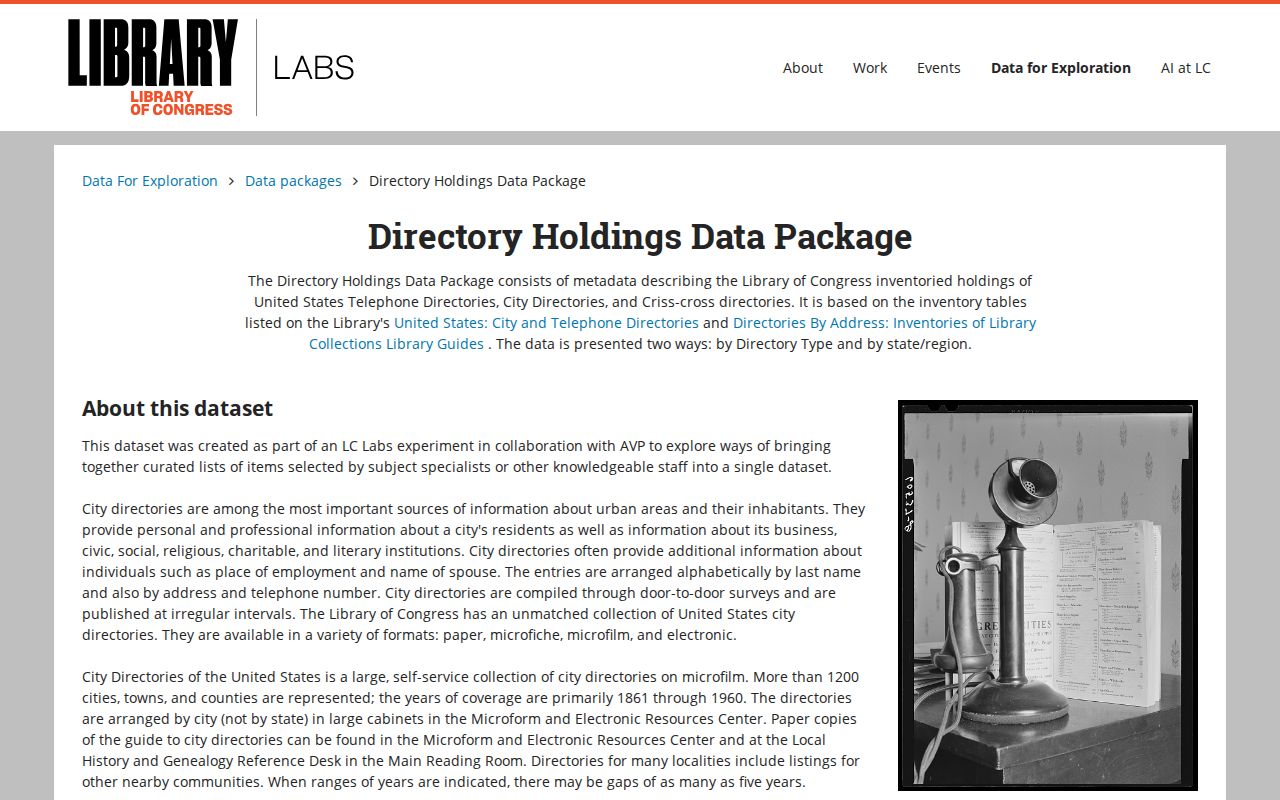
The captured source view below shows the Library of Congress directory discovery environment.
Use its metadata to identify the right issue, then save the scan page number and image identifier with each entry. FamilySearch’s broader United States City and Business Directories collection covers about 1749 through 1990, but local years and image rights vary. Ancestry Library Edition is available onsite at Aalfs rather than assumed to be available from home.
Read Sioux City Directory Entries
Read the key before expanding any mark. A Sioux City city directory entry can show a person’s exact printed name, initials, honorific, spouse or household note, occupation, firm, business address, home address, room or apartment, and telephone. Record the volume title, year, publisher, page, section, and scan identifier too. Those details make the result reproducible and keep two people with the same name from being merged.
| Name | Copy spelling, initials, title, and household notation exactly. |
|---|---|
| Work detail | Record occupation, firm, and business address only when printed. |
| Address | Preserve street number, street name, unit, and whether it is marked home or residence. |
| Phone | A listed number identifies a subscriber entry, not every person in the household. |
| Source | Save edition, page, section, and image identifier. |
- Criss-cross directory
- A later directory arranged by street address or telephone exchange rather than surname.
- Householder index
- An address-led listing used to identify the named person associated with a home.
- Abbreviation key
- The volume’s own list defining marks such as residence, home, widow, or boards.
Never expand a code from memory. Publishers changed their conventions, and the retained research did not include a stable person-specific sample page.
Sioux City Records Timeline
Directory books make more sense beside the city’s record history. Sioux City was platted in 1854, and Woodbury archival land and naturalization groups begin in the 1850s. Printed records later filled the long intervals between census years. The city’s 1901 numbering rules are especially important when an address changes between nearby editions.
- 1854: Sioux City was platted, establishing an early map and land-record frame.
- 1869-1877: A literary association preceded the collection’s transfer to city control.
- 1901: Municipal street-number rules took effect, so older addresses may need conversion.
- 1913: The Carnegie library at Sixth and Jackson was dedicated.
- 1990: Aalfs began serving from its present Pierce Street site.
The city’s official history also links early Sioux City to the Missouri and Floyd Rivers, Native Yankton Sioux and Omaha communities, Lewis and Clark, Sergeant Charles Floyd, and Theophile Bruguier. These names and landmarks can be used as search terms in classified pages and newspapers, but they do not identify a resident by themselves.
Sioux City Museum Name Files
The Sioux City Museum Research Center adds material a directory cannot hold. Its more than 60,000 subjects include people, houses, streets, architecture, businesses, immigration, military history, and real estate. The center is at 607 4th Street, with access from Jackson Street between 4th and 5th. It is open Wednesday through Friday, 1:00 to 5:00 p.m.; appointments are appreciated. Call 712-224-5001 or email museumresearch@sioux-city.org.
The museum’s public research page, shown below, explains this onsite and request-based access.

Materials remain onsite. Copies are listed at 25 cents per sheet and digital reproductions at $1. Ask with a directory year, printed address, exact name, and subject type. The virtual collections can add photographs and local context, while the Research Center can check unscanned files.
Pair Sioux City Census Years
Iowa census records help when the annual sequence breaks. State census years include 1856, 1885, 1895, 1905, 1915, and 1925. Federal schedules through 1950 are generally open under the 72-year release rule, but the 1890 federal census was destroyed. A nearby Sioux City city directory can narrow the street and household before the census image is read.
The State Historical Society census collection explains the state, federal, special, and mortality schedules. Treat WCGS and FamilySearch compilations as finding aids. Check the underlying image when a birth place, age, relationship, or address matters.
Trace Sioux City Family History
A careful family trail keeps each statement tied to a year. Begin with one known name and inspect likely spelling variants, middle initials, and surname forms. Then move through adjacent editions rather than jumping decades. A sudden address shift may reflect the 1901 numbering system, a move, a printing error, or a different person.
- Find the first likely entry and save the full source citation.
- Check the prior and next available city directories for continuity.
- Compare the street section or criss-cross list when the volume has one.
- Pair the dated address with the nearest state or federal census.
- Test the name and date in Journal microfilm, yearbooks, and cemetery records.
Disappearance does not prove death. The household may have moved, chosen an unlisted phone, fallen between editions, or appeared under another spelling. For a modern address-keyed task, the Sioux City street directory handles parcel and street records without turning an old directory entry into a current claim.
Sioux City Directory Fallbacks
When local shelves stop, broaden the source type. The State Historical Society’s Woodbury County holdings include land transfers, probate, naturalization, vital, tax, and divorce groups with date spans beginning in the nineteenth century. NARA identifies federal Sioux City naturalization declarations from 1932 through 1983 and petitions from 1932 through 1988. These records may explain why a name appears, changes, or vanishes from a run.
The Woodbury County Genealogical Society offers WAHKAW issues from 1981 through 2023, second-Saturday meetings at Morningside Library, and research help. Its compilations can point to a record, but the original should settle any key fact. Keep separate labels for directory address, census residence, legal ownership, and a name in a newspaper.